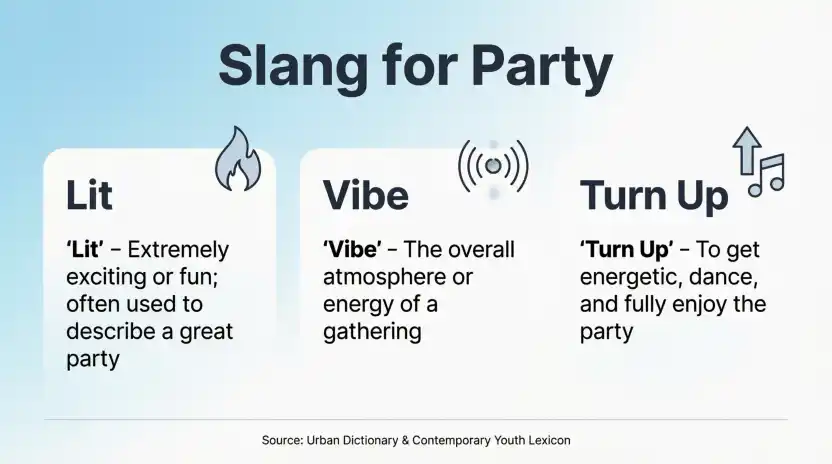
If you are looking for slang for party, common choices include bash, shindig, rager, get-together, kickback, and turn-up.
These words can make a party sound more casual, fun, wild, or social, depending on the context. People search for “slang for party” because the word “party” can feel too plain for texts, captions, chats, and social media posts.
They may also want to understand what friends mean when they use words such as “rager” or “kickback.” The main confusion is that not every slang word means exactly the same type of party.
A kickback is often small and relaxed, while a rager usually suggests a loud and energetic event. Some terms are also more common in certain places or age groups. This guide explains popular slang for party, what each term means, where it fits, and when you should avoid it.
If you need a fun caption, a text message, or a better understanding of online language, these examples make the differences easy to see.
Slang for Party and Quick Answer
“Slang for party” includes casual words and phrases people use instead of simply saying “party.”
| Slang term | Simple meaning | Typical feeling |
| Bash | A fun party | Casual |
| Shindig | A social gathering | Playful |
| Rager | A very energetic party | Wild |
| Kickback | A small, relaxed gathering | Chill |
| Get-together | A casual social event | Friendly |
| Turn-up | A lively celebration | Energetic |
| House party | A party at someone’s home | Casual |
| Blowout | A very large or exciting event | Big |
| Hangout | Time spent socializing | Relaxed |
| Celebration | An event for a special occasion | Neutral |
Quick examples
- “Are you going to the bash tonight?”
- “We’re having a small kickback on Saturday.”
- “That was a huge rager.”
- “Let’s have a chill get-together.”
- “The birthday blowout starts at eight.”
The best word depends on the type of event and the people you are talking to.
Definition and Meaning of Slang for Party
“Slang for party” means informal words or expressions used to describe a party, celebration, or social gathering.
The word “party” itself is already common and informal in many situations. Slang gives the word a different tone.
Bash
“Bash” is a common informal word for a party.
Example:
“We’re having a birthday bash this weekend.”
It can describe anything from a small celebration to a large event.
Shindig
“Shindig” is a playful word for a social gathering or party.
Example:
“Thanks for inviting me to the shindig.”
It often sounds humorous or old-fashioned rather than serious.
Rager
“Rager” usually describes a very energetic or intense party.
Example:
“They had a huge party last night.”
This word has a stronger meaning than a normal “get-together.”
Kickback
“Kickback” usually means a small, relaxed social gathering, often at someone’s home.
Example:
“We’re having a little kickback after school.”
The term suggests a casual atmosphere rather than a formal event.
Get-together
“Get-together” is a broad term for people meeting socially.
Example:
“We’re having a family get-together on Sunday.”
It is less slang-heavy than “rager” or “bash.”
Turn-up
“Turn-up” is informal language for lively celebration or having a good time.
Example:
“It’s time to turn up for the celebration.”
Its meaning can change with context, so it is best suited to casual conversations and social media.
The Origin of Slang for Party
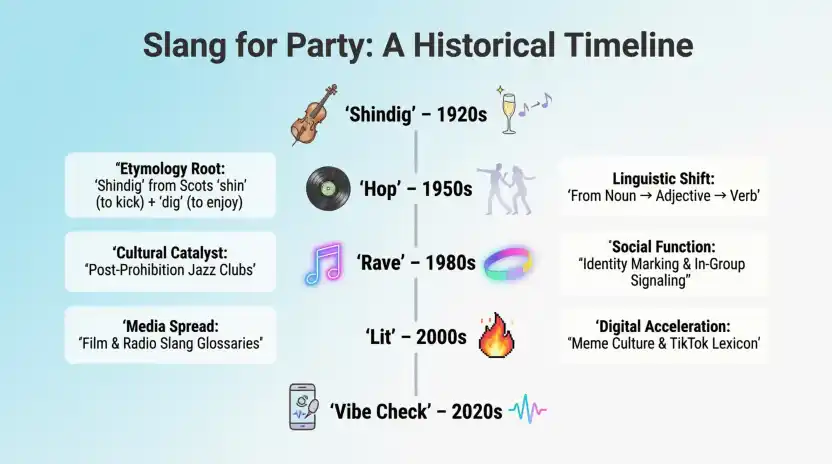
There is no single origin for “slang for party” because it refers to many different expressions.
The word “party” has a long history. It developed from words connected with a group or part of something. Over time, “party” became widely used for a social gathering.
Many party slang terms appeared later through regional speech, popular culture, music, youth language, and everyday conversation.
Why are there so many terms?
Language changes because people create shorter, funnier, or more expressive ways to describe familiar things.
For example:
- “party” is neutral and direct.
- “bash” sounds more exciting.
- “shindig” sounds playful.
- “kickback” suggests a relaxed gathering.
- “rager” suggests a high-energy event.
Some terms become popular for a few years, while others stay in everyday English for much longer.
The meaning of slang can also change over time. A word that sounds normal to one generation may sound old-fashioned to another.
British English vs American English Spelling
“Slang for party” does not have one special British or American spelling rule.
Most party slang words have the same spelling in both varieties of English.
For example, Americans and British speakers can both use words such as “bash,” “party,” and “get-together.”
The bigger difference is often which expression sounds natural, not how it is spelled.
| Expression | American English | British English | Difference |
| Party | Common | Common | Same |
| Bash | Common | Common | Same |
| Shindig | Used | Used | Same |
| Get-together | Common | Common | Same |
| Rager | Common informal term | Less common | Usage differs |
| Kickback | Common in informal US speech | Less common | Usage differs |
| Turn-up | Informal | Less common | Usage differs |
| House party | Common | Common | Same |
British and American speakers may understand the same slang, even when one term is more popular in one region.
Which Slang for Party Should You Use?
The best term depends on your audience.
For American English
Words such as “bash,” “kickback,” “rager,” and “house party” may work well in casual American conversations.
Example:
“We’re having a kickback this weekend.”
For British English
“Party,” “get-together,” “do,” and other local expressions may sound more natural depending on the setting.
Example:
“We’re having a little get-together on Saturday.”
For a global audience
Use simple terms such as:
- party
- celebration
- get-together
- house party
These are easier for international readers to understand.
For school or professional writing
Avoid slang unless the assignment or topic specifically discusses slang.
Instead of:
“The company had a huge bash.”
Use:
“The company held a large celebration.”
The second version sounds more professional.
Common Mistakes with Slang for Party
Slang is easy to misuse because words can have different meanings.
Mistake 1: Treating every slang word as a synonym
A “kickback” and a “rager” do not usually suggest the same atmosphere.
Better: Choose the term that matches the event.
Mistake 2: Using slang in formal writing
Slang can sound too casual in a report, application, or formal email.
Better: Use “party,” “event,” “celebration,” or “gathering.”
Mistake 3: Assuming regional slang works everywhere
A term that is popular in one country or community may sound unusual somewhere else.
Better: Think about your audience before using unfamiliar slang.
Mistake 4: Confusing “turn up” and “turn-up”
“Turn up” can function as a verb phrase, while “turn-up” may appear as an informal noun or expression.
Better: Check the sentence and intended meaning.
Mistake 5: Using “rager” for every party
“Rager” normally gives the idea of a very energetic party.
Better: Use “get-together” for a calm social event.
Slang for Party in Everyday Examples
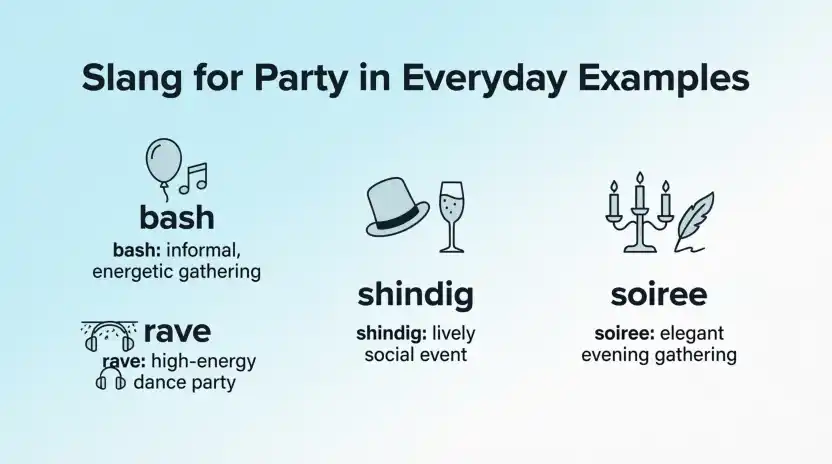
Slang for party appears in texts, social media, casual speech, and entertainment writing.
In text messages
“Are you coming to the bash tonight?”
“We’re having a small kickback tomorrow.”
On social media
“Weekend vibes at the house party.”
“What a night!”
Social media often uses short and catchy party expressions because they work well in captions.
In casual conversation
“That was a fun get-together.”
“Did you hear about the party this weekend?”
In news writing
News articles usually avoid slang unless the term is part of a quote, event name, or cultural discussion.
For example:
The organizers described the event as a large community celebration.
This is clearer and more neutral than using a slang term.
In formal writing
Formal writing should normally use:
- event
- celebration
- gathering
- reception
- social event
Example:
“The school organized a community gathering.”
This is more suitable than:
“The school organized a huge bash.”
Slang for Party & Google Trends & Usage Data
Interest in party slang can change by country, age group, platform, and culture. There is no single worldwide search trend for every slang term.
Some terms are broad and easy to understand, while others are strongly linked to specific communities or regions.
For example, “party” has a much wider everyday use than “rager” or “kickback.” Social media can also make certain slang terms more visible for a short period.
What affects slang popularity?
Several factors can influence how often a term appears online:
- Social media trends
- Music and entertainment
- Regional speech
- Age groups
- Online communities
- Memes
- Popular creators
- Cultural events
Search interest can also change quickly. A slang term may become popular on TikTok, Instagram, or another platform and later become less common.
For SEO content, it is better to explain the meaning and context of each term instead of claiming that one slang word is universally the most popular.
Slang for Party Variations Compared
Here is a quick comparison of the most useful party slang terms:
| Term | Meaning | Tone | Best use |
| Bash | Party | Fun | Casual speech |
| Shindig | Social gathering | Playful | Casual writing |
| Rager | Very energetic party | Strong/casual | Friends |
| Kickback | Relaxed gathering | Chill | Texts |
| Get-together | Social meeting | Neutral | General use |
| Turn-up | Lively celebration | Energetic | Social media |
| House party | Party at a home | Casual | Everyday speech |
| Blowout | Large celebration | Exciting | Casual speech |
| Hangout | Informal social time | Relaxed | Texting |
The key difference is tone. “Get-together” is broad, while “rager” suggests a much more energetic event.
FAQs About Slang for Party
1. What is slang for party?
Common slang for party includes “bash,” “shindig,” “rager,” “kickback,” “get-together,” and “turn-up.”
2. What is a fun word for party?
“Bash” is a simple and popular fun word for party, while “shindig” gives the phrase a more playful tone.
3. What does bash mean in slang?
“Bash” is an informal word for a party or celebration.
4. What does rager mean?
“Rager” usually refers to a very energetic or intense party.
5. What does kickback mean in slang?
A “kickback” usually means a small, relaxed social gathering.
6. Is “shindig” slang for party?
Yes. “Shindig” is an informal and playful word for a party or social gathering.
7. Can I use party slang in formal writing?
It is usually better to use neutral words such as “event,” “celebration,” or “gathering” in formal writing.
Conclusion
Slang for party gives people many ways to describe a social event with a different tone. Words such as “bash,” “shindig,” “rager,” “kickback,” and “get-together” can all refer to a party, but they do not always create the same feeling.
“Bash” is a simple casual choice, while “shindig” sounds playful. “Kickback” suggests a smaller and more relaxed gathering, while “rager” usually suggests a much more energetic event. Regional use also matters.
A slang word that feels natural in American English may be less common in British English or other varieties of English. For global readers, simple terms such as “party,” “celebration,” and “get-together” are usually safest. In professional and academic writing, neutral language is better than slang.
The main rule is simple: choose the word that matches your audience, setting, and the type of event you mean. Understanding these differences helps you sound natural without using slang in the wrong situation.
Read more about!
- Aurapilled Meaning in Slang: What It Really Means
- Vibecore Meaning Slang: Definition, Uses & Examples
- Old School Slang: Meaning, Examples, and Popular Terms

Daniel Brooks is an English vocabulary educator who creates simple, practical guides on slang, word meanings, and everyday English. His goal is to help students, writers, and English learners expand their vocabulary and communicate with confidence.