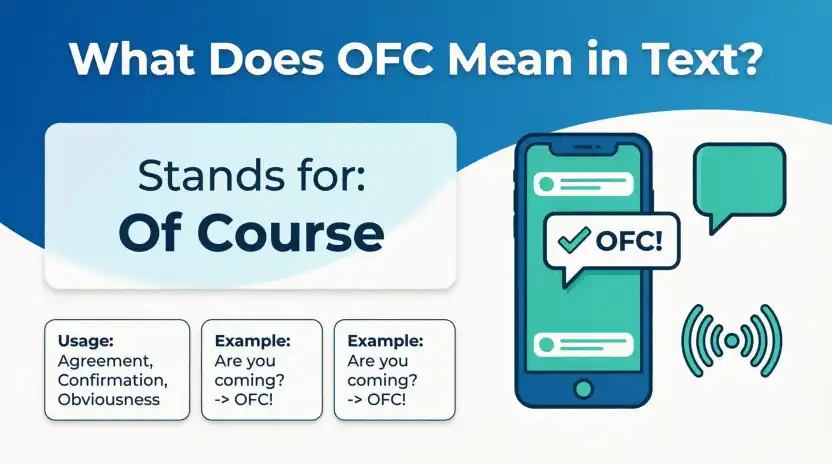
If someone texts you “OFC,” they usually mean “of course.” It is a casual texting abbreviation used to agree, confirm something, reassure someone, or say “yes” quickly. You may see it in texts, TikTok comments, Snapchat, Instagram DMs, WhatsApp, and group chats.
You may be searching for “in text what does OFC mean” because the abbreviation can look confusing if you have never seen it before. The good news is that its main meaning is simple.
OFC is usually just a shorter way to type “of course.” The tone can change with the situation, punctuation, emojis, and the relationship between the people talking.
This guide explains what OFC means, how people use it, where you may see it, how to reply, and when it is better to write the full phrase.
What Does OFC Mean in Text?
OFC means “of course” in text messages and casual online conversations.
It is an informal abbreviation rather than a completely different word. People shorten “of course” to OFC because it is quick and easy to type.
For example:
“Are you coming with us?”
“OFC!”
This simply means:
“Of course!”
People often use OFC when they want to:
- Agree with someone
- Confirm something
- Say yes
- Reassure someone
- Show that something is obvious
- Give a quick answer
- Keep a conversation casual
Wiktionary lists “ofc” as an internet slang and text-messaging abbreviation of “of course.”
Is OFC slang or an abbreviation?
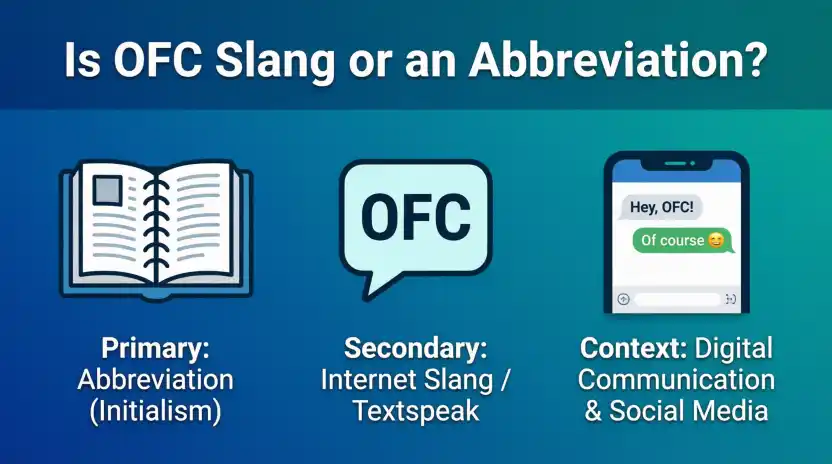
OFC is best described as a texting abbreviation and a form of internet slang.
It does not create a completely new meaning for “of course.” Instead, it shortens the phrase for casual digital communication.
You can think of it like this:
| Full phrase | Texting version |
| Of course | OFC |
| I don’t know | IDK |
| I don’t care | IDC |
| In my opinion | IMO |
| Be right back | BRB |
OFC belongs to the same broad family of internet abbreviations.
What Does OFC Mean in Everyday Chat?
In everyday chat, OFC usually means “yes,” “sure,” “definitely,” or “of course.”
The exact feeling depends on the sentence.
For example:
“Can I call you later?”
“OFC.”
Here, OFC sounds like a friendly yes.
Another example:
“You’re still coming, right?”
“OFC!”
Here, the writer is confirming the plan with confidence.
It can also be used inside a sentence:
“OFC I remember.”
That means:
“Of course I remember.”
The abbreviation is especially natural when people already know each other and do not need formal language.
Why Do People Use OFC?
The main reason is convenience.
Typing “of course” takes more time than typing three letters. In fast conversations, short forms can make messages quicker.
OFC also fits the relaxed style of texting. People do not normally write messages to friends in the same way they write essays or formal letters.
Compare these:
“Of course, I can help you.”
and:
“ofc, I can help”
Both communicate the same basic idea. The second feels more casual.
Texting abbreviations such as OFC became part of a wider online habit of shortening common phrases. There is no reliable evidence that one specific website, person, or viral post invented OFC. It is more accurate to describe it as part of the broader development of internet and text-message shorthand.
Where People Use OFC
OFC does not have a completely different definition on each social platform. Its basic meaning remains “of course.”
What changes is the type of conversation where you may see it.
| Platform | How OFC Is Used | Example |
| TikTok | Comments and casual replies | “OFC I watched it 😂” |
| Snapchat | Snaps and private chats | “OFC, send it” |
| DMs and comments | “OFC I’ll like it” | |
| Private and group chats | “OFC, no problem” | |
| SMS | Normal text conversations | “OFC I’m coming” |
OFC on TikTok
On TikTok, OFC can appear in comments, replies, captions, and private messages.
Someone might write:
“OFC this is my favorite song.”
The meaning is simply:
“Of course this is my favorite song.”
It may also be used sarcastically, depending on the video or comment.
For example:
“OFC it started raining today 😭”
This could mean:
“Of course it started raining today.”
The writer may be joking about an annoying or predictable situation.
OFC on Snapchat
Snapchat conversations are usually casual, so OFC fits naturally.
Example:
“Are you sending the picture?”
“OFC lol”
Here, the sender is saying yes in a relaxed way.
OFC on Instagram
On Instagram, you may see OFC in DMs, comments, or replies.
For example:
“You’re coming to the party, right?”
“OFC!”
It can also appear in comments:
“OFC you look amazing!”
The exact tone comes from the rest of the message.
OFC on WhatsApp
OFC is also easy to use in WhatsApp chats.
Example:
“Can you send me the address?”
“ofc, one sec”
There is no special WhatsApp definition. It still means “of course.”
OFC in SMS
In ordinary SMS texting, OFC usually works exactly the same way.
For example:
“Can you pick me up?”
“OFC.”
The short answer means “Of course.”
How the Tone of OFC Can Change
OFC usually sounds friendly or neutral, but context can change how the message feels.
Consider these examples.
Friendly
“Can you help me with this?”
“OFC 😊”
The emoji makes the response feel warm.
Excited
“You’re coming with us?”
“OFC!!!”
The extra punctuation adds excitement.
Casual
“Want pizza?”
“ofc 😂”
The lowercase letters and emoji make it feel relaxed.
Serious or direct
“Are you sure?”
“OFC.”
The period can make the reply feel more firm or final.
That does not mean a period automatically makes OFC rude. People have different texting habits. The surrounding conversation matters more than capitalization or punctuation alone.
10 Real Chat Examples Using OFC
Here are realistic examples showing how people use the abbreviation.
Example 1: Making Plans
A: “Are you still coming tonight?”
B: “OFC! I wouldn’t miss it.”
Here, OFC confirms the plan.
Example 2: Asking for Help
A: “Can you help me with this homework question?”
B: “ofc, send it over.”
The sender is offering help.
Example 3: Asking Permission
A: “Can I borrow your charger?”
B: “OFC.”
This is a simple yes.
Example 4: Reassurance
A: “Are you still my friend after that?”
B: “OFC 😭”
Here, OFC reassures the other person.
Example 5: Group Chat
A: “Who wants to play later?”
B: “OFC 😂”
C: “I’m in too.”
The abbreviation is being used as a quick agreement.
Example 6: Instagram DM
A: “Did you see my new post?”
B: “OFC! It looks great.”
OFC means “of course.”
Example 7: Snapchat
A: “Send me that snap.”
B: “OFC lol.”
The response is casual and friendly.
Example 8: Obvious Question
A: “You knew I was joking, right?”
B: “OFC 😭”
The reply means “Of course I knew.”
Example 9: Making a Request
A: “Can you save me a seat?”
B: “ofc, I got you.”
Here, OFC is a quick confirmation.
Example 10: Funny Situation
A: “Did you really order pizza again?”
B: “OFC 😂”
The writer may be joking because ordering pizza is expected or typical for them.
How to Reply When Someone Says “OFC”
You do not need a special response to OFC.
Your reply depends on what the person is saying.
Funny Replies
If the conversation is playful, you might answer:
“I knew you would 😂”
or:
“That was the answer I wanted.”
Casual Replies
A simple:
“Cool!”
or:
“Thanks!”
works well.
Friendly Replies
You can respond with:
“Aww, thanks!”
or:
“You’re the best!”
Neutral Replies
If you want to keep things simple:
“Okay, sounds good.”
or:
“Got it.”
The important thing is to read the message before deciding what tone to use.
Is OFC Rude or Offensive?
OFC is not normally rude or offensive.
Its main meaning, “of course,” is a normal English phrase. The abbreviation simply makes it shorter.
Still, any phrase can sound different depending on context.
For example:
“OFC I know.”
could be friendly.
But if someone is arguing and writes:
“OFC I know.”
it might sound impatient or sarcastic.
That does not mean OFC itself is offensive. The surrounding conversation creates the tone.
Is OFC safe to use?
For ordinary casual conversations, yes. It is a common type of texting shorthand.
However, there is an important difference between casual communication and formal writing.
For school assignments, official letters, applications, formal reports, and most professional emails, write:
“Of course”
instead of:
“OFC”
The full phrase is clearer and more appropriate in formal writing.
Is OFC Appropriate at School or Work?
It depends on the situation.
If you are texting a friend from school, OFC is fine in a casual conversation.
For example:
“OFC, I’ll bring the notes tomorrow.”
But a formal school assignment should use standard English.
Instead of:
“OFC this proves the point.”
write:
“Of course, this supports the point.”
The same idea applies at work.
A casual team chat may be relaxed, but a formal email or report usually calls for the complete phrase.
A simple rule is:
Use OFC for casual digital communication. Use “of course” for formal writing.
Who Uses OFC?
OFC is used by people who communicate through texting and online chats.
It is especially natural in informal digital communication because the abbreviation is short and easy to understand.
Gen Z and younger internet users
You may see OFC frequently in casual conversations among younger internet users, including social-media comments, DMs, group chats, and gaming communities.
That does not mean only Gen Z uses it. People from different age groups can understand and use common texting abbreviations.
Is OFC popular online?
OFC is a well-established texting abbreviation rather than a brand-new trend.
Current online language references continue to define it primarily as “of course.”
There is no need to claim an exact percentage of people who use it because reliable usage statistics are not available for every platform and age group.
Its use can vary based on someone’s personal texting style, age, community, and platform.
Can OFC Have Another Meaning?
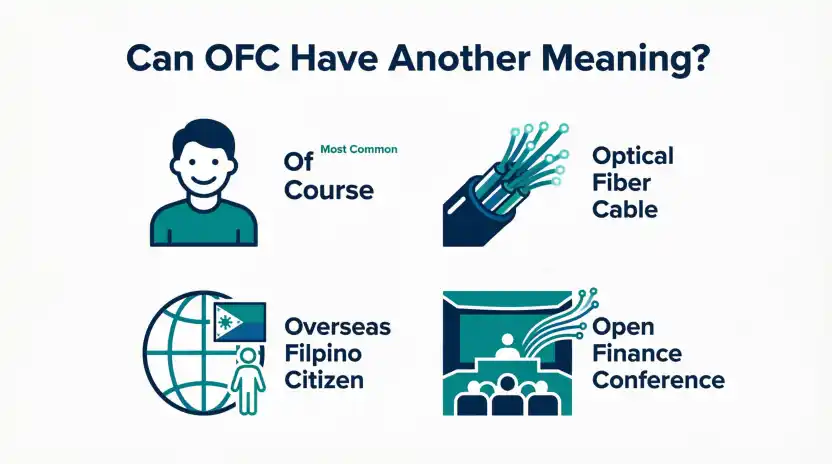
Yes. Context can matter because the same three letters can have meanings outside ordinary texting.
For example, in fan-fiction communities, OFC can mean “original female character.” Some reference sources also list technical, sports, business, and organizational meanings for the acronym.
But if you receive a casual text such as:
“OFC, I can come.”
the intended meaning is almost certainly:
“Of course.”
There is no reason to look for a specialized definition unless the surrounding conversation points toward one.
What about “of fucking course”?
Some online slang references also document a less common interpretation of OFC as “of fucking course.”
This reading depends heavily on context.
It may appear when someone is being very emphatic, frustrated, or sarcastic.
For example:
“OFC the bus is late again.”
Depending on the conversation, the sender may simply mean “of course,” or they may be using a stronger, profane interpretation.
Do not assume the profane meaning automatically. The ordinary meaning is “of course.”
Origin of OFC
The exact origin of OFC as a texting abbreviation is not clearly documented.
There is no strong evidence showing that one person, social-media platform, or specific viral event created it.
Instead, OFC fits into the larger history of internet shorthand.
People have long shortened common phrases in online communication. Abbreviations such as IDK, BRB, IMO, and BTW became useful because they let people communicate quickly.
OFC follows the same basic pattern.
The phrase “of course” is common in everyday English, so shortening it to three letters is easy to understand.
One language reference describes OFC as a text-messaging and internet abbreviation, while older online references show that the shorthand has been documented for many years.
It is better to say that OFC developed through online and texting culture than to claim a precise invention date without solid evidence.
OFC vs IDK vs IDC vs IMO vs BRB
These abbreviations can appear together in the same kinds of online conversations, but they have very different meanings.
| Abbreviation | Meaning | Type | Usage | Popularity |
| OFC | Of course | Texting abbreviation | Agreement, confirmation, reassurance | Common |
| IDK | I don’t know | Texting abbreviation | Uncertainty or lack of knowledge | Common |
| IDC | I don’t care | Texting abbreviation | Showing lack of concern or preference | Common |
| IMO | In my opinion | Texting abbreviation | Giving a personal opinion | Common |
| BRB | Be right back | Texting abbreviation | Temporarily leaving a chat | Common |
The words are not interchangeable.
For example:
“Are you coming?”
“OFC.”
means:
“Of course.”
But:
“Are you coming?”
“IDK.”
means:
“I don’t know.”
And:
“Are you coming?”
“IDC.”
would mean:
“I don’t care.”
Understanding the full phrase behind each abbreviation makes these conversations much easier to follow.
Real-World Usage Example
Imagine two friends are planning to meet after school.
One person sends:
“Are we still getting food after school?”
The other replies:
“OFC. What do you want?”
Here, OFC means “of course.”
The person is confirming that the plan is still happening. The second sentence then moves the conversation forward by asking what they want to eat.
This is a good example of how OFC works in real communication. It is not normally used as a complicated slang expression. It is simply a quick way to give an affirmative answer.
You can often replace OFC with “sure,” “definitely,” or “of course,” depending on the exact situation.
When Should You Use OFC?
OFC works best when the conversation is casual.
Good places to use it include:
- Text messages
- Group chats
- DMs
- Casual social-media comments
- Gaming chats
- Conversations with friends
- Informal online communities
For example:
“Can you send me that picture?”
“OFC.”
That sounds natural in a casual chat.
You can also combine it with other casual language:
“ofc lol”
or:
“OFC 😂”
The extra words or emoji can help show the intended mood.
When Should You Avoid OFC?
There are situations where writing “of course” is better.
Avoid OFC in:
- Academic assignments
- Formal essays
- Official applications
- Formal reports
- Important professional emails
- Business documents
- Formal letters
The abbreviation is not necessarily wrong because people can understand it. It is simply less formal.
For example, instead of:
“OFC, I will attend the meeting.”
a professional email would normally say:
“Of course, I will attend the meeting.”
That small change makes the message fit the setting better.
Common Mistakes About OFC
Mistake 1: Thinking OFC always sounds enthusiastic
It does not.
“OFC!” may sound excited, while “ofc.” may sound much more neutral or direct.
Mistake 2: Assuming OFC is always rude
It is not normally rude.
The tone depends on the surrounding message.
Mistake 3: Using OFC in every situation
It is best for informal communication. Formal writing should usually use “of course.”
Mistake 4: Assuming OFC only means one thing everywhere
In ordinary texting, “of course” is the main meaning. But specialized communities can use OFC for other things.
Mistake 5: Thinking capitalization changes the definition
“OFC” and “ofc” generally mean the same thing.
Capitalization can affect how a message feels, but it does not automatically create a new definition.
Frequently Asked Questions
What does OFC mean in text messages?
OFC usually means “of course.” It is an informal abbreviation used to agree, confirm something, reassure someone, or give a quick yes. For example, “Can you help me?” followed by “OFC!” simply means “Of course!”
What does OFC mean on TikTok?
On TikTok, OFC usually means “of course.” You may see it in comments, replies, captions, or private messages. The platform does not give OFC a special standard definition. The meaning stays the same, although the tone can change depending on the conversation.
Is OFC slang?
Yes. OFC is commonly described as an internet slang or texting abbreviation for “of course.” It is informal rather than formal English. People use it mostly in casual digital conversations where short messages are normal.
Is OFC rude or offensive?
No, OFC is not normally rude or offensive. It simply means “of course.” However, a message containing OFC can sound sarcastic, impatient, or annoyed depending on the context. The abbreviation itself does not automatically carry a negative tone.
How should you reply to OFC?
Reply according to the conversation. If someone says “OFC” after agreeing to something, you can say “Thanks,” “Cool,” or “Sounds good.” If the conversation is playful, you can answer with an emoji or joke. There is no special reply required.
Key Takeaways
- OFC usually means “of course.”
- It is a casual texting abbreviation and internet slang term.
- People use it to agree, confirm, reassure, or say yes quickly.
- You can see it in texts, TikTok, Snapchat, Instagram, WhatsApp, and group chats.
- OFC is normally not rude or offensive.
- Use “of course” instead of OFC in formal school or work writing.
- Context can sometimes give OFC a different or sarcastic meaning.
- Specialized communities may use OFC for other terms, but “of course” is the normal texting meaning.
Conclusion
If you see “OFC” in a text message, the simplest answer is usually “of course.”
It is a short, informal abbreviation people use to agree, confirm something, reassure another person, or give a quick yes. You may see it in SMS messages, WhatsApp chats, TikTok comments, Snapchat conversations, Instagram DMs, and other casual online spaces.
The tone is flexible. “OFC!” can sound excited, while “ofc” may feel relaxed and “OFC.” may sound more direct. The surrounding conversation matters more than the letters themselves.
OFC is fine for casual conversations, but “of course” is a better choice for school assignments, formal emails, reports, and other professional writing.
Once you know that OFC means “of course,” most uses are easy to understand. When the context is unusual, simply read the surrounding messages before deciding what the sender means.
Read more about!
- Big Meaning Slang: What Does “Big” Mean?
- Cho Meaning Slang: What Does “Cho” Mean?
- Cow Slang Meaning: What Does “Cow” Mean in Slang?
Hi, I’m Ryan Mitchell. I write simple guides about slang, internet language, and everyday English to make modern expressions easy to understand. My goal is to help learners use real-life English with confidence.